Elevator shafts, as the core support structures for elevator operation, have material choices that directly impact elevator safety, durability, and maintenance costs. In elevator shaft construction, hot-dip galvanized (HDG) square tubes and cold-dip galvanized (CDG) square tubes are two common choices based on different galvanizing processes.
Analysis of Advantages and Disadvantages of Hot-Dip Galvanized Square Tubes versus Cold-Dip Galvanized Square Tubes for Elevator Shafts
IntroductionAnalysis of the advantages and disadvantages of hot-dip galvanized square tubes and cold-dip galvanized square tubes for steel structure elevator shafts
Elevator shafts, as the core support structures for elevator operation, have material choices that directly impact elevator safety, durability, and maintenance costs. In elevator shaft construction, hot-dip galvanized (HDG) square tubes and cold-dip galvanized (CDG) square tubes are two common choices based on different galvanizing processes. This paper will systematically analyze the advantages and disadvantages of these two materials from dimensions such as performance, cost, and application scenarios, to provide reference for elevator shaft design.
Hot-Dip Galvanized Square Tubes: The Preferred Option for Long-Term Protection
- Excellent Corrosion Resistance: The hot-dip galvanizing process forms a zinc-iron alloy layer through immersion in molten zinc at 450°C, with a zinc layer thickness of 35-140μm. It can maintain rust-proofing for over 50 years in suburban environments and about 20 years in urban areas. The zinc layer has self-healing properties, protecting the base steel through sacrificial anode action.
- Comprehensive Structural Protection: It achieves full-surface coating, including recessed areas and corners, providing seamless corrosion protection. The zinc layer forms a metallurgical bond with the substrate, offering strong adhesion and resistance to mechanical damage during transportation and installation.
- Economic Advantage: Although the initial cost is higher, its 30+ year maintenance-free characteristic results in significantly lower lifecycle costs compared to cold-dip galvanized options. Standardized production processes ensure better quality stability than on-site coating solutions.
- Application Limitations:
- Processing Adaptability Constraints: High-temperature treatment may cause slight deformation in thin-walled tubes, making them unsuitable for precision components. The surface roughness is higher and requires additional processing for secondary operations like spraying.
- Higher Initial Investment: The process requires substantial equipment investment, with processing costs 30%-50% higher than cold-dip galvanizing. Higher zinc consumption also leads to relatively higher material costs.
Cold-Dip Galvanized Square Tubes: The Flexible Choice for Short-Term Applications
- Outstanding Process Adaptability: The room-temperature electroplating process does not alter the base material's physical properties, making it especially suitable for thin-walled tubes and precision components. The smooth surface can be directly subjected to secondary processing like powder coating or baking.
- Significant Cost Benefits: Initial costs are 20%-30% lower than hot-dip galvanizing, with lower equipment investment requirements. The zinc layer thickness is controllable (5-25μm), making it suitable for scenarios with high decorative requirements.
- Environmental Characteristics: The electroplating process generates fewer organic solvent emissions and has lower drying energy consumption, offering better environmental performance.
- Application Limitations:
- Insufficient Durability: The zinc layer is physically adhered, leading to potential rusting after 3-5 years of outdoor use. Damaged areas can form galvanic cells, accelerating corrosion of the base material, and the zinc layer depletes quickly in humid environments.
- Limited Protection Range: It typically only achieves single-sided or partial coating, with a protection range less comprehensive than hot-dip galvanizing. The adhesion is weaker, and the zinc layer is easily damaged and falls off.
- High Maintenance Costs: Long-term use requires regular maintenance, and lifecycle costs may exceed those of hot-dip galvanized options. In new buildings, its use as a water pipe has been prohibited.
Application Recommendations for Elevator Shafts:
- Hot-Dip Galvanized Square Tubes are suitable for:
- Elevator shafts in high-rise buildings (requiring long-term protection)
- Projects in humid environments or coastal areas
- Projects with strict maintenance cycle requirements, such as public buildings
- Structural shaft schemes involving overall hoisting of steel structures
- Cold-Dip Galvanized Square Tubes are suitable for:
- Temporary elevator facilities with short-term use
- Indoor decorative shafts (requiring subsequent spraying)
- Budget-constrained renovation projects
- Narrow shaft spaces with spatial constraints
Conclusion
For elevator shafts, which demand high safety and durability, hot-dip galvanized square tubes, with their excellent corrosion resistance and lifecycle economy, are the preferred choice for long-term projects. Cold-dip galvanized square tubes are more suitable for short-term, decorative, or budget-constrained special scenarios. It is recommended to conduct a comprehensive evaluation based on project service life, environmental conditions, and budget factors.
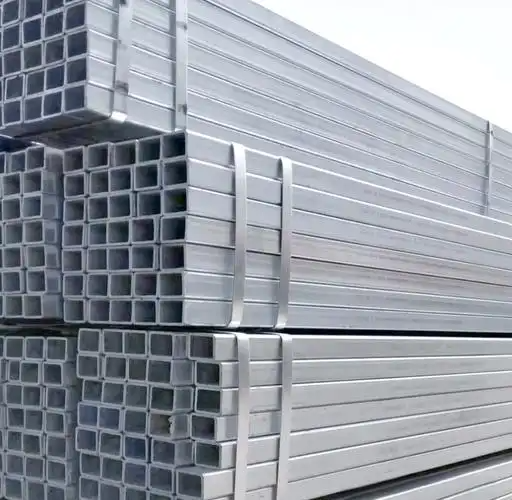
Hot-dip galvanized square tube: The surface typically features zinc flakes, with a coarser texture, thicker coating, and an overall darker color.
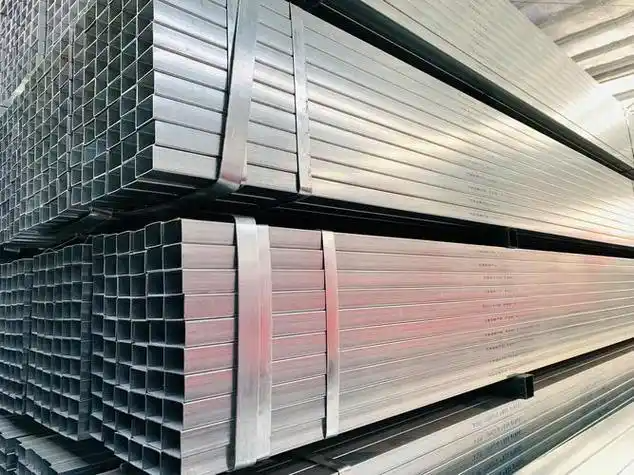
Cold-dip galvanized square tube: smooth and delicate surface, bright color, thin zinc coating.
| Comparative Dimension |
Hot-dip galvanized square tube |
Cold Galvanized Square Tube |
| Core Process |
High-temperature hot-dip galvanizing (450℃-480℃) forms a zinc-iron alloy layer |
Ambient temperature electrogalvanizing, with pure zinc layer physically adhering |
| Coating Thickness |
35-140 micrometers (thickness) |
5-25 micrometers (thin) |
| Adhesion |
Metallurgical bonding, strong adhesion |
Physical attachment, with weak adhesive force |
| Corrosion Resistance |
Extremely strong, with outdoor durability of over 20 years |
Limited, prone to rusting in 3-5 years |
| Surface State |
It is relatively rough and has zinc flakes |
Smooth and delicate |
| Cost |
Higher (material + processing) |
Lower |
| Applicable Scenarios |
Preferred locations for elevator shafts: high-rise, humid, coastal, public buildings |
Temporary facilities, indoor decorative shafts, and renovation projects with limited budgets |
Advice: Elevator shafts have high requirements for safety and durability, and hot-dip galvanized square tubes are highly recommended. Although the initial investment is large, their excellent corrosion resistance and whole-life cycle cost-effectiveness can maximize structural safety and reduce maintenance costs.

